4000 – 2350 BC
- All ancient empires began in the fertile lands between the Euphrates and Tigris rivers. Later, the Romans would call this place Mesopotamia “Land Between Two Rivers”.
- The ancient name of the Euphrates, URUTTU, means “copper river”.
- The Sumerians, thought to have migrated from Central Asia, settled between the Euphrates and Tigris in 4000-2350 BC and established a great civilization.
- Their first king, Alulim, “Descended from the Sky” to the city of Eridu, and Alalgar, who followed him, reigned for an even longer period.
- They founded the city-states, the most important of which were Ur, Uruk, Larsa, Lagash and Kish. These city-states, which produced pottery in bulk, rapidly became rich due to their proximity to sea and land trade routes.
- The most prominent sector was bronze production. Bronze was used in making statues, household tools and weapons.
- Walled cities with suburbs extending up to 10 km around each emerged. Perhaps 40,000 people lived in these large cities.
The most strategically well-located of these cities was Kiş, and therefore the richest.
- After 2800 BC, they tried to dominate each other.
- Around 2400 BC, a king named Lugalzagesi conquered the city-states of Ur, Uruk and Lagash, establishing the first Sumerian union.
- In the lands of the Fertile Crescent, where water, grain, game, minerals and trees abound, more people began to live and continue their lives.
- Cities surrounded by mud brick walls formed, protecting people from floods and hungry attackers.
- When life became complicated for the Sumerians, who began to engage in agriculture, they needed a leader. Armed men are also needed to enforce the decisions of the powerful leader. Leaders become kings. This means the beginning of civilization and the first king’s appearance on the stage of history.
- With King Etana, kingship begins to be passed down through blood ties. A class is born to rule, an aristocracy is formed. Kingship becomes a sacred position to a certain extent. Nobility by birth will never go away.
- Eridu, the first city where kingship descended from the sky, appears before us as a Sumerian paradise (according to Babylonian legends, it was created by the God-King Marduk). This is the paradise in the Torah-Genesis.
- It is written in the Sumerian king list that 8 kings reigned. The 5th King was DUMUZI (July)
- As the city-states of the Sumerians grew stronger, they fought each other. The Elamites, who grew stronger in Iran, began to attack the Sumerians after 2500 BC.
- The end of the Sumerians was brought by a person named SARGON, who is thought to be a Semite. While he was on duty in the palace of King Urzababa of Kish, he became the king of Kish and eventually destroyed the social unity of the Sumerians with wars. 2279 BC
- In the inscription describing Sargon’s birth, his life is as we often see in history. After his mother gave birth, she put him in a basket, left him in the river, he was picked up by someone named AKKI in the river, Akki raised him as his own child.
- The possibility that Sargon was Semitic is due to Akki having a Semitic name.
- The Akkadians (who spoke a Semitic language) under Sargon’s rule erased the Sumerians from history. Sargon defeated Lugalzagesi. He became the first emperor in history.
- Sargon says on a tablet, “I conquered with bronze axes.”
- About 1600 years after Sargon, one of the Neo-Assyrian kings would use his name.
- Both the Akkadian and Babylonian civilizations that came after the Sumerians bear traces of the Sumerians.
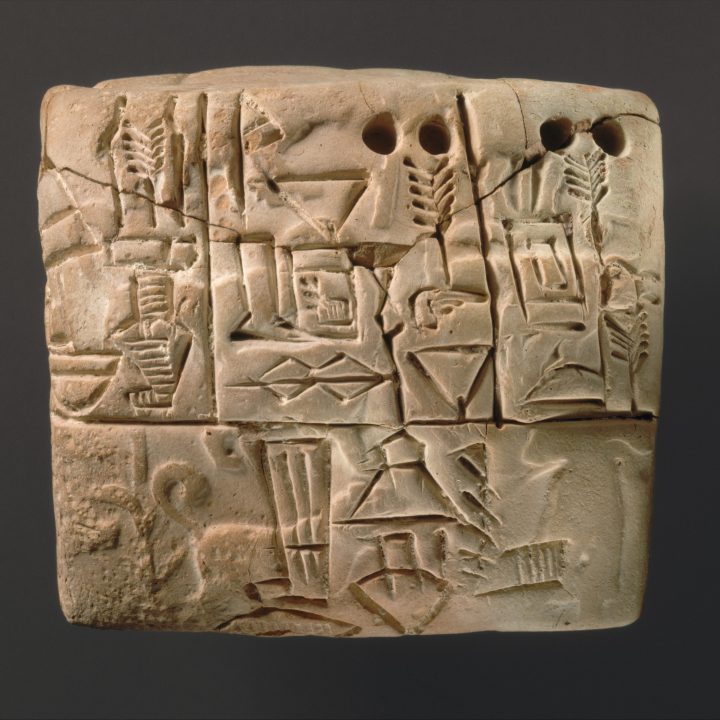
- After the Sumerians discovered cuneiform, they wrote down the wars they won, their trade, their temples and of course the achievements of their kings on tablets. These were written by scribes whose salaries were paid by the kings.
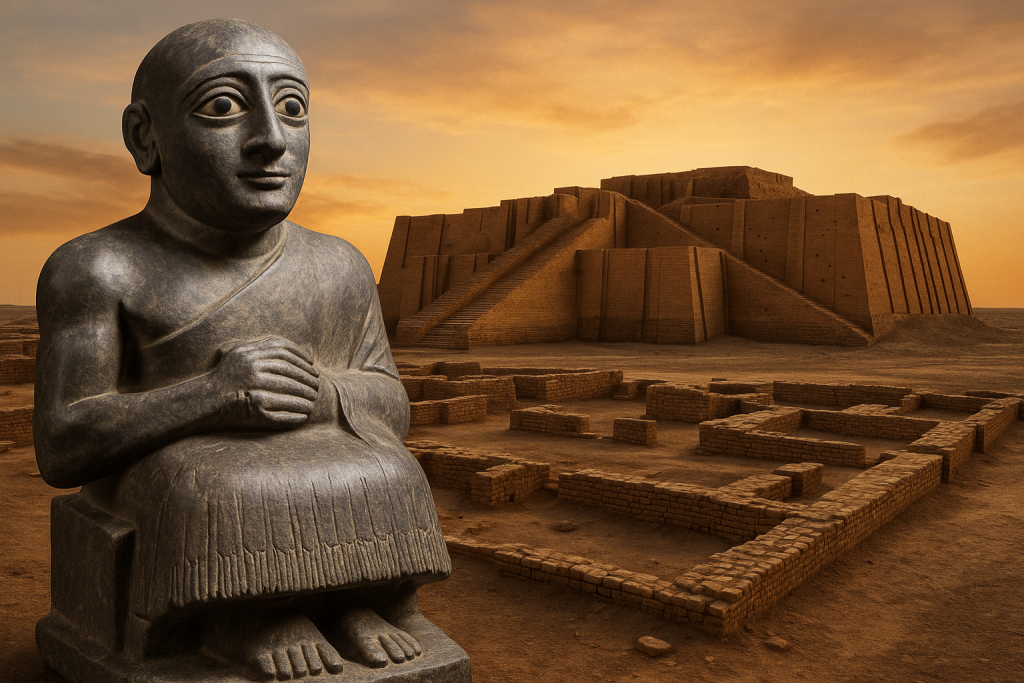
The Sumerians believed in polytheistic religions. They called their temples in the city center Ziggurat.
The Sumerians directly influenced all the civilizations around them.

THE FLOOD
- The story has reached us indirectly, translated into Akkadian from an Assyrian library.
The king of the gods, ENLIL, cannot sleep because of the noise of the people in the world, and he will convince the other gods to destroy the people. However, the god EA, who has sworn to protect humanity, informs the wise man UTNAPISHTIM of this news. Utnapishtim escapes by getting on a boat with his family and some animals.
The Babylonian version of the same story is called “The poem of Atrahasis”. Which means “super wise man”.
- The most famous one is the Noah story told in the Torah-Genesis today.
- In the 19th century, geologists partially searched for traces of this story; they found sea shells on the tops of mountains and a layer of silt (silt) at a depth of 3 meters separating the first Mesopotamian settlements from the later ones.
- Mesopotamian experts think that this was not a global flood, but a Mesopotamian flood.
- What is interesting is that there are similar stories in the American continent. These date back long before the missionaries who took Genesis with them.
- In the Mayans, the “400 sons” are saved from the Flood by turning into fish. In Peru, a llama refuses food, tells his owner that the waters will rise in five days, the man climbs the mountain, and when he returns, he repopulates the world (there is no woman climbing the mountain in the story).
- There is a separate list of kings who came after the Flood. The 13th king after the Flood is ETANA. After this, they start urbanizing.
- King Gilgamesh’s father was probably a high priest, not a king. Gilgamesh wanted it all: loyal people, the throne, the kingdom, and immortality. He is called LILLU in the king list.
- After years of war and struggle, Gilgamesh kills the giant, defeats the Bull of Heaven, defies the Goddess Inanna, and conquers a larger area in the land of Sumer than any king has ever ruled.
WRITING
- The Sumerians invent Cuneiform in 3500 BC. With the invention of writing, art and literature developed.
- Sumerian words are built on monosyllabic roots. Words from other languages have also entered Sumerian. However, two-syllable words are also seen. These words are from the Semitic language and are related to agriculture.
- The first written documents were found in the city of Uruk.
- Some tablets also contain lists of words for reading and practicing.
- Numerous “textbook” tablets dating back to 2500 BC were unearthed in excavations carried out in 1902.
Their alphabet consists of symbols.
- The Sumerians were the first to establish written legal rules and the first state governed by law.
- As an agricultural and animal husbandry society, they discovered the sciences of Mathematics, Geometry and Astronomy.
- They used four-operation calculations.
- They are the first known society in many fields such as writing, language, medicine, astronomy, mathematics, religion, fortune-telling, magic and mythology.
SUMERIAN LITERATURE
A large portion of the tablets belonging to Sumerian literature were found during the excavations of the city of Nippur (today known as Nif-fer) by the University Museum of Philadelphia, USA, between 1887 and 1890. According to the law of the time, these tablets were randomly shared between the Istanbul Archaeological Museums and the institution conducting the excavation. Some tablets that were found elsewhere or obtained illegally were also distributed to European and American museums, and it is estimated that there are 5000 in total. Almost 1/3 of these are in the Cuneiform Documents Archive of the Istanbul Archaeological Museums.
Prof. Samuel Noah Kramer (died in 1990 at the age of 93) played the greatest role in bringing to light the Sumerian literature consisting of legends, epics, hymns, laments, elegies, love poems, proverbs, stories and wisdom compositions, and therefore the sacred marriage texts that constituted the fertility cult. He determined cuneiform tablets and their subjects for exactly 60 years, and presented them as a source to Sumerologists, science historians, and anthropologists with various publications.
The greatest contribution was made by the Istanbul Archaeological Museums Cuneiform Documents Archive.
Muazzez İlmiye Çığ (Inanna’s Love, Belief and Sacred Marriage in Sumer)
SUMERIAN LITERATURE
A large portion of the tablets belonging to Sumerian literature were found during the excavations of the city of Nippur (today known as Nif-fer) by the University Museum of Philadelphia, USA, between 1887 and 1890. According to the law of the time, these tablets were randomly shared between the Istanbul Archaeological Museums and the institution conducting the excavation. Some tablets that were found elsewhere or obtained illegally were also distributed to European and American museums, and it is estimated that there are 5000 in total. Almost 1/3 of these are in the Cuneiform Documents Archive of the Istanbul Archaeological Museums.
Prof. Samuel Noah Kramer (died in 1990 at the age of 93) played the greatest role in bringing to light the Sumerian literature consisting of legends, epics, hymns, laments, elegies, love poems, proverbs, stories and wisdom compositions, and therefore the sacred marriage texts that constituted the fertility cult. He determined cuneiform tablets and their subjects for exactly 60 years, and presented them as a source to Sumerologists, science historians, and anthropologists with various publications.
The greatest contribution was made by the Istanbul Archaeological Museums Cuneiform Documents Archive.
Muazzez İlmiye Çığ (Inanna’s Love, Belief and Sacred Marriage in Sumer)