When I saw Göbeklitepe, I thought that it was decided very quickly that this place was a temple. In this article, I will try to discuss the following question about Göbeklitepe within my own field: Was Göbeklitepe a temple?
The development of humanity is almost parallel to the development of a single person in terms of its biological and mental aspects. With the biological evolution of humans largely completed and humans becoming homo sapiens sapiens (smart humans who know they are smart), the historical development of humanity begins with the hunter-gatherer period and extends to the current capitalist phase. While seeking an answer to the question of “Was Göbeklitepe a temple?”, which is the subject of this article, I will try to make predictions about the mental/spiritual worlds of the hunter-gatherer people of Göbeklitepe based on the similarity between the mental development of a child and the development of humanity.
On the one hand, our genes, on the other hand, the cultural accumulation of humanity determines our current level of mental development. There are major structural changes in our nervous system that begin at birth and continue rapidly, especially in the first two years. It can be said that these changes are largely specific to our species, that is, they are the result of our biological evolution. After our first two years, the development of our brain is almost complete until after puberty. In fact, learning every new information and behavior throughout our entire lives causes micro-level structural changes in the brain. Our mental development progresses as a result of the dynamic interaction of our genes and our environment, as well as the effort we put into ourselves (for today) by reading, asking, and learning.
A child thinks concretely until the age of 6-7; for example, being told “you broke my heart” makes the child think that the heart is an object that breaks into pieces.
Another thinking characteristic of a child is being animistic; that is, he thinks that the objects around him are alive. When he hits his head on the table, his mother’s anger at the table and punishing it comforts him. Another thinking characteristic of a child is omnipotence; he thinks that he can control what is happening around him with the power of thought. When he puts on his Spider-Man costume, he can fly between buildings like him.
Omnipotence is also related to magical thinking, which is a characteristic of children’s thinking. Logic does not work in magical thinking, and unrealistic connections are established between facts and events.1,2 If you pay attention, the stories we tell children often contain almost all of these characteristics of thinking.


We call children of this age “play children”. Play is not something that can be easily said and passed over. Play is a way of self-expression for children whose language and communication skills are not yet fully developed. Play has a restorative function in negative experiences. For example, in the pictures drawn by a child who had a serious surgery, “cavalarlar” was frequently mentioned in his games; after repeated games with the same theme, that child was saved from monsters. It can be observed that traumatic experiences are repeated in children’s games; but this time the strings are in the child’s hands and he makes the players play in the same way he wants in the same event. The child has control over all the elements of the game; he sets up the game himself, determines the people who will take part in the game and how they will behave, and makes them talk the way he wants. In this way, children can make sense of their lives and what is happening around them, and they feel relaxed by experiencing a sense of control. In this way, it becomes easier for them to cope with their negative feelings and fears when necessary. Most of us have witnessed the curiosity of three-four year old children about dinosaurs. Being able to hold the toy version of the dinosaur they are afraid of in their hands means that they have gained control over this fear.
The Childhood of Humanity
As I said at the beginning, the similarity between the development of humanity and the development of a single human being can help us understand the Göbeklitepe people. The dating of the Göbeklitepe ruins is based on the Early Neolithic Period.3 This period is a development level that corresponds to the childhood of humanity. During this period, human communication through language and speech is one of humanity’s greatest leaps. The development of thinking depends on the development of language and social relationships. However, in these ages, thought and mental development have not yet reached their current levels.
While Freud was actually investigating the origin of “neuroses”, he focused on animistic thinking in his work Totem and Taboo, writing, “It cannot be said that man established his first universe system solely under the inspiration of speculative curiosity. A practical need such as controlling the world around him must also have played a role. For example, we would not be surprised to see that a knowledge system showing how to establish dominance over people, wild animals and objects developed hand in hand with the animistic system.” He explains the function of magic as bringing natural events under the will of man, with examples from the lives of tribes that mostly fed themselves with hunting. He also likens the psychological state of children to that of these tribes.4 Freud’s childhood and primitive tribes.
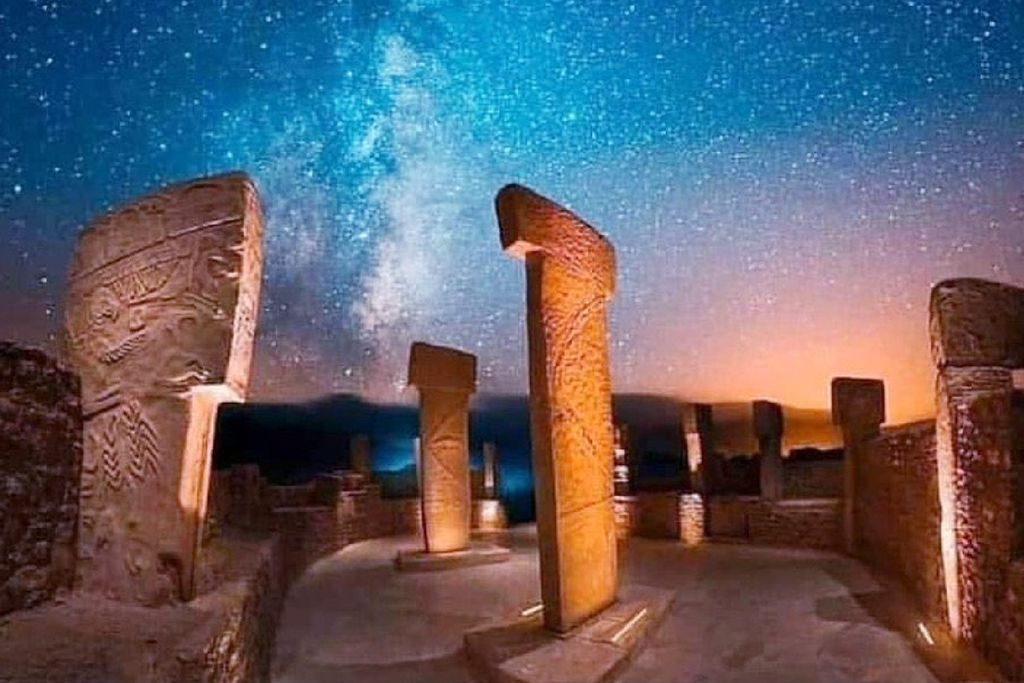
The first thing that draws attention in Göbeklitepe, located near Urfa, are the T-shaped structures that are up to 7 meters long and are formed in a circle. When you look at these structures more closely, you can see lizard, wild boar, fox, snake and other animal figures on them. The hunter-gatherer Göbeklitepe people have a struggle with nature, it is important for them to control what is happening in their natural environment. In addition to the rewards they can obtain from nature as food in their daily lives, such as non-predatory animals, there are predatory animals that make their life difficult and scare them. One way for them to control the difficulties they have to deal with in their natural life and their fears may be the structures they build and the pictures they draw, just like children control the power of monsters through play. The magnificent height of the T-shaped structures in Göbeklitepe may well symbolize power. This is a language, a form of expression, omnipotent thinking, and it tells us “I am strong.” (I remember experiencing the most striking effect of this when I went to see the British Parliament building. I felt very small and powerless next to that building; I thought that the purpose of building these buildings was to make those who could not enter the building experience these feelings. The skyscrapers erected today are also a representation of the power of money and power.) The animal figures on these structures probably functioned like toys that children included in their play scenarios and made them experience the feeling of omnipotence.
Without taking into account the daily life of the people of the period, their experiences in their relationship with nature, their mental capacity, and their relationship with nature and animals, it is not right to claim that Göbeklitepe is a temple. The temple was built to worship power. If the claim of a temple does not emphasize the supernatural powers or god/gods worshiped by the people of Göbeklitepe, whose abstract thinking has not yet developed, then what is meant by the term “temple” should be explained. I hope that the proposition in this article can also provide a hypothesis for those who will work on Göbeklitepe and similar sites.
İnci Özgür İlhan
Prof. Dr. Specialist in Mental Health and Diseases