“Give me (a long enough lever and) a solid support point, and I will move the world.” Archimedes (3rd century BC)
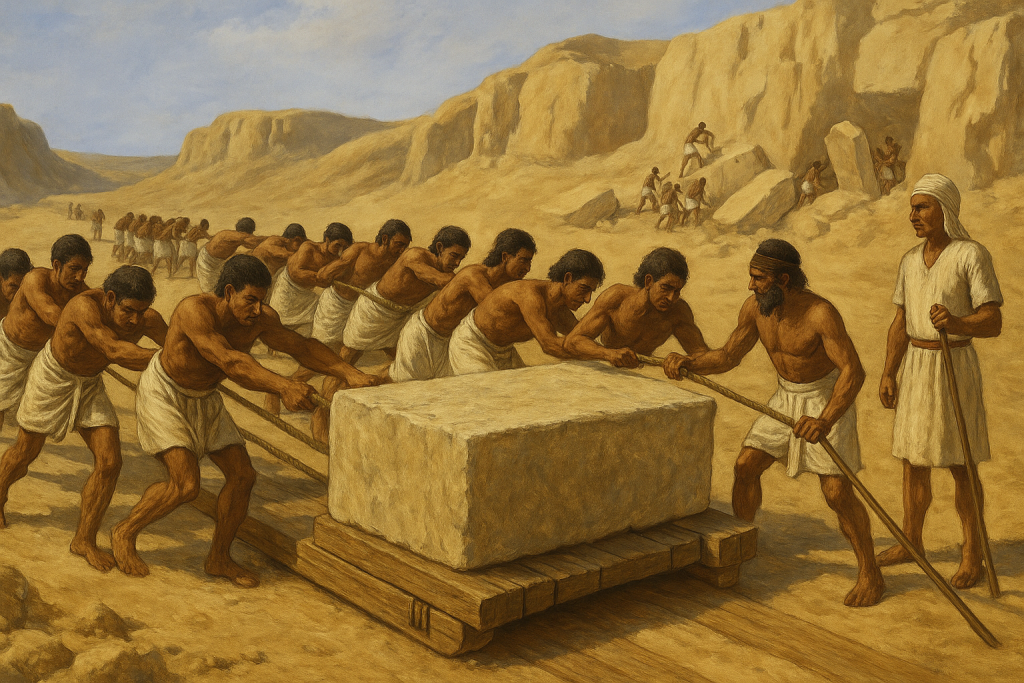
In ancient times, stones were usually transported with the help of wood. This was done by adding quarter, half, or full round woods to help them roll, or by placing the stone inside the wood. For this, protrusions were left on the stone to help the stones connect to the wood, or metal additions were made. Before the stones were transported from the mine, their rough sides and thin ends were chipped, thus facilitating transportation and not carrying too much weight.
No matter how skillfully the blocks were extracted from the quarries, if the transportation methods were not safe, all the labor could be wasted. During the transportation of the stones, there was a possibility of cracks not only on their surfaces but also inside them, which could not be seen from the outside. These internal cracks would later shorten the life of the structure, and over time, the stone would crack from the inside, break and be destroyed. Therefore, a very good organization was necessary for transportation.
The important thing was that the surface to be carried should be smooth and necessary precautions should be taken for the heavy stones not to sink into the ground. Therefore, the road was built before transportation. The waste stone pieces formed in the quarries were laid on the road and the top was flattened. The roads were supported with tight stone mesh. The stones would take at least a part of the way they would go on this road. Since there was not enough stone material around Didyma, the roads were supported with waste stones taken from the marble quarries and thus the vehicles carrying the heavy blocks were prevented from sinking.
The stone cut from the quarry was moved either by putting it on a sled or by pulling it directly on logs. In order to carry the roughly shaped columns in the quarry, slots were opened on the column heads and iron was poured into these slots to make a kind of handle. After wooden frames were placed on these iron bars, they were pulled by a group of ox-horses. This method was invented by Khersiphron, the architect of the Temple of Artemis in Ephesus.
Wheels are at the forefront in the transportation of heavy blocks that are not cylindrical. In order to prevent them from getting stuck or sinking into the ground, wheels made of wooden material were made with wide widths. For example; column capitals could not be carried by rolling because they were square or rectangular in section. For this purpose, two wheels made of wide width and sturdy rods, approximately 3.5-4 m in diameter, were placed on them and rolled.


Large sleds were also used for transportation. While the sleds used for small blocks were initially pulled by rubbing on the road surface with the help of ropes, logs were later placed under the sleds and the sled moving on the logs was prevented from rubbing on the road.
Four-wheeled carts pulled by oxen or horses were generally used for transportation. In the case of large blocks, the number of axles of the cart was increased and the load was spread over 6-8 wheels, thus preventing it from being exposed to a weight that would damage the road.
Vitruvius; He says that this method was possible because the quarries were not too far from the construction site (10-13 km) and the land between them was smooth and flat. The risk of damage to the stones increased as the distance increased.
Rollers were generally used for rocks transported to distant places.
In the Roman period, with the increase in possibilities, different techniques began to be used in transportation methods. Blocks placed in wooden cylinders with a diameter of 4-5 meters were pulled by oxen and mules with the help of ropes. However, the cylinder could not be steered with this method, so there was a possibility of going off the road.
In sea transportation, large blocks were not placed directly into the ship. This was both unsafe and impractical. Large blocks were carried on a wooden structure formed by connecting them with a yoke between two ships. In this way, the weight of the stone was reduced by taking advantage of the buoyancy of the water.